By Guest Blogger Dan Lewis
Editor of Now I Know
 Dan Lewis is the force behind the free daily email service Now I Know. Like the old adage you learn something new every day, Now I Know feeds your mind with a variety of different things each day with which you can impress your work colleagues, friends and family. Or not. Whether you keep this new knowledge to yourself is up to you. However, you should really think about subscribing - click the image to take you there or subscribe to his newsletter here.
At a young age, children in the United States learn -- via a common toddler tune -- that ants congregate and march, as a horde, toward a common destination.
Here is the first verse of the nursery rhyme.
The ants go marching one by one, hurrah, hurrah
The ants go marching one by one, hurrah, hurrah
The ants go marching one by one,
The little one stops to suck his thumb
And they all go marching down to the ground
To get out of the rain, BOOM! BOOM! BOOM!
While this isn't true for all ants, it is indeed the life of a few hundred species of ant, collectively known as "army ants." Army ants are typically nomadic, traversing great distances in search of food before setting up temporary nests, only to move again shortly thereafter.
The main foragers lead the way and emit pheromones -- chemical secretions other army ants can detect -- in order to give the rest of the clan a trail to follow. Those ants which can't detect the pheromones (a situation which commonly happens as armies grow large) simply follow a nearby ant. This allows for army ant brigades to extend for extraordinary lengths, at times observed to extend a half-mile long.
The children's rhyme goes on... and on, until it reaches its climax in its tenth verse.
The ants go marching ten by ten, hurrah, hurrah
The ants go marching ten by ten, hurrah, hurrah
The ants go marching ten by ten,
The little one stops to say "THE END"
And they all go marching down to the ground
To get out of the rain, BOOM! BOOM! BOOM!
So, that's a happy ending for those ants. But what happens when a group of ants loses the pheromone scent? Who leads? The answer: No one. Or everyone, depending on your perspective. The ants form an "ant mill" -- a continuously rotating circle of ants, each following one another, but going, net, nowhere, as demonstrated in the videos below.
The ant mill is, ultimately, fatal, as the ants die of exhaustion.
Bonus Fact
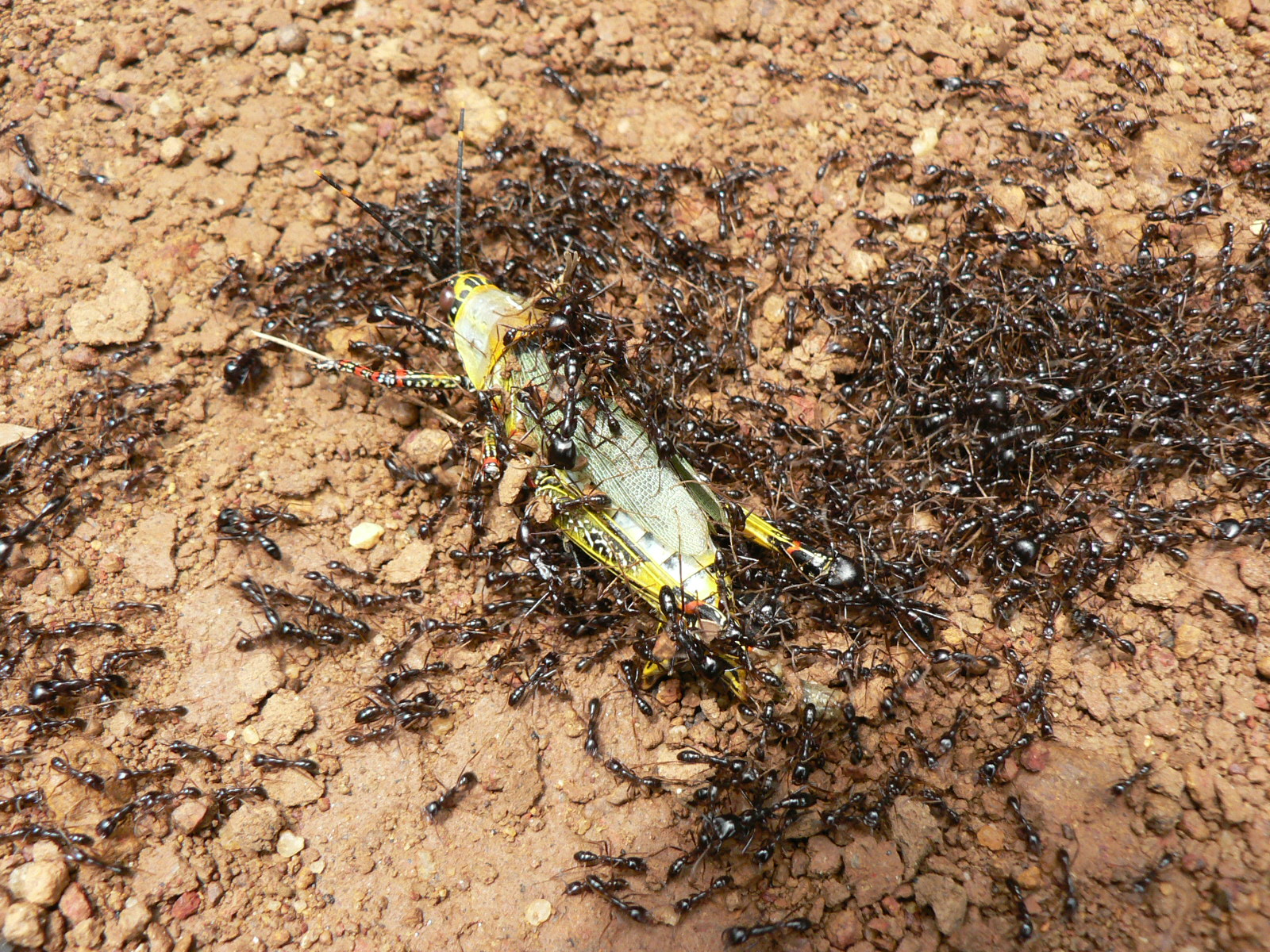
One type of army ant, those of the genus Dorylus, (seen above) are particularly dangerous. Native primarily to central and east Africa, armies of Dorylus ants can number up to 50,000,000 -- that'sa number 33% larger than the (human) population of California. By human standards, these columns move slowly, a mere twenty meters each hour, so in most cases, Dorylus are a significant nuisance -- but not much else. However, by sheer force of numbers, Dorylus have been known to overwhelm human victims too young or frail to move, causing suffocation and eventually, death.