The page cannot be found

Possible causes:


  • Baptist explanation: There must be sin in your life. Everyone else opened it fine.
  • Presbyterian explanation: It's not God's will for you to open this link.
  • Word of Faith explanation: You lack the faith to open this link. Your negative words have prevented you from realizing this link's fulfillment.
  • Charismatic explanation: Thou art loosed! Be commanded to OPEN!
  • Unitarian explanation: All links are equal, so if this link doesn't work for you, feel free to experiment with other links that might bring you joy and fulfillment.
  • Buddhist explanation: .........................
  • Episcopalian explanation: Are you saying you have something against homosexuals?
  • Christian Science explanation: There really is no link.
  • Atheist explanation: The only reason you think this link exists is because you needed to invent it.
  • Church counselor's explanation: And what did you feel when the link would not open?

Sanderlings

Thursday, 28 April 2011


The Sanderling is a small wader. It is a circumpolar Arctic breeder, and is a long-distance migrant, wintering south to South America, South Europe, Africa, and Australia. It is highly gregarious in winter, sometimes forming large flocks on coastal mudflats or sandy beaches.

Oh and it is also a very funny bird to watch. They often stand on one leg and hop along like Long John Silver. Plus although they congregate close to the sea they really don’t seem to want to get wet so every time a wave comes in, away they hop and run!

This marvelous piece of filmmaking was created by Javier Salinas Laguna. It’s a gorgeous piece of film and the music ("Playful by the dozen" by Daniel Pemberton) is particularly well chosen.

Otters Beat Up a Gibbon

Friday, 22 April 2011


Yes, you read correctly. Otters and gibbons are not normally associated with inter-species rivalry but strange things can go in those places which we refer to as zoos.

Here, Zagreb Zoo is the scene of an encounter between a gibbon – who just seems to be minding his own business – and two pesky otters, seemingly intent on ruining the gibbon’s day.

Fortunately the gibbon has one thing up his sleeve – height. Swing away, you funky gibbon!

My Father's Garden


Sometimes the world can seem very large – at other times miniscule.  This amazing short film plays on both of those feelings.

Mirko Faienza shot his father’s garden in Bologna, Italy, with all the requisite wildlife.  It is all shot in gorgeous colors and the attention to detail is quite amazing. 

Add to that the fact that the music suits it so very well and you have six minutes of bliss!

Danger in Paradise

Tuesday, 19 April 2011


Spring is a wonderful time and it can be experienced in so many different ways.  There is nothing quite like taking in the beauty of a spring day from the top of a hill, just to take in the panorama. 

On the other hand, if you look closely there are whole worlds beneath your feet.

This charming short film does just that and focuses in on one plant pot. After a harsh winter, life begins to stir again.  However, around any corner danger may lurk!

Hats off to Gunther Machu who made this film and captured numerous insects very up close and personal.

The Luminous Deep

Monday, 18 April 2011


The Luminous Deep is a short animated documentary made by Kevin Adams and Amy Scott-Murray, two final-year Animation students at Duncan of Jordanstone College of Art.

The fact that it was made by two undergraduates makes it even cooler in my opinion – the quality of the animation is awesome, particularly when you realize that their budget was hardly Spielbergian. The documentary was made with the assistance of researchers at Aberdeen University's Oceanlab.

During the short animation, we learn the fate of a dead whale that sinks to the darkness of the seabed, and how its carcass can come alight by nourishing a huge interconnected community of scavengers and predators. Most of these creatures produce glowing lights that researchers theorize would create a brilliant firework display in the abyssal night.

The Mystery of Mad Horse Disease on Easter Island

Sunday, 17 April 2011


This is a sad story, but it could have a happy ending. Easter Island is one of the most remote inhabited islands on earth. In the 1860s horses and cows were introduced by missionaries. The few thousand people who live there now depend on the animals for transportation for food. However, recently some of the horses have become emaciated, slowly dying.

For the past twenty years the horses had been getting sick with what the islanders called Mad Horse Disease (aka Caballa Loco). No one knew where it came from or what caused it. He made a discovery – that the livers of horses had been poisoned. Then, a holiday visit to the island by Jonathan Arzt, a veterinary, led to a discovery which could mean a solution.

This film was directed, shot, written and edited by Laura J Boyd.

Breaking the Law

Saturday, 16 April 2011


I am trying to avoid a royal theme, what with the media saturation of the royal wedding between William and Kate coming up, but although the Queen’s favorite dogs are corgis, I would be very much surprised to see one of hers acting in this manner!  It’s funny but I always think of corgis as sedate little animals – I stand corrected!

Add a soundtrack – Breaking the Law by Judas Priest and you have a short, but perfect record of one small pooch’s attempt to usurp authority and do things his way.  I just hope the owners of the golf course don’t find out anytime soon!

Rat on a Cat on a Dog

Sunday, 20 March 2011


You just do not get to see this every day – a rat on a cat on a dog. It sounds like something out of a bizarre yet ancient nursery rhyme which has been banned by the politically correct brigade.

Yet, here it is, shot in downtown San Francisco.

Yup, a rat on a cat on a dog – all acting as if it is the most normal thing in the universe.

Well, we all make our own normal, so who are we to argue?

Sea Star Time Lapse

Tuesday, 22 February 2011


This is a great piece of time lapse photography, showing a sea star (or star fish as we call them in the UK) slowly crawling across Mora Beach, Olympic Peninsula, Washington.

It is only when you watch one of these remarkable creatures in slow motion that you realize just how alien they are – to us at least. It really does look like something out of a science fiction film!

This is one day of shots, not edited. The first scene is tiny barnacles on a rock with little black snails so you do have to wait a little while until it gets to the sea stars.

We Are All Connected

Saturday, 5 February 2011


This is the latest campaign by the World Wildlife Fund and it is an excellent piece of animation which shows that however intricately, everything on planet Earth is connected. 

It is a lot gentler than some of their recent short ads but it nevertheless gets its point across just as well – which goes to show that you don’t always have to shock in order to make people think.

Happy Tails - Charlie's Pets

Saturday, 22 January 2011


Some people have a pet, other one or two. Charlie Boucher of Vancouver in Canada has literally hundreds.  One of the reasons for this is that he owns one of the biggest domestic fish tanks I have ever seen.  Here he gives his tips about how to maintain a perfect tank environment in the fish tank and how to deal with issues such as sick fish.

He also gives, simply by telling us what is involved, an insight in to the amout of time that is needed to set up and maintain a tank of this size - it really isn't something that should be entered in to lightly.

He also has a number of other pets, such as gheckos, and two adorable dogs.This is episode 7 of the Canadian TV Series, Happy Tails. New episodes can be found on Novus Channel 4 in Vancouver.  If you don't receive that channel - ie you don't live in Canada, then you can see this and other episodes of Happy Tails online from the official Novus YouTube channel.   Thanks to director Anthony Bortolussi for sharing this with us.

Army Ants Go Marching – Until…

Friday, 21 January 2011


By Guest Blogger Dan Lewis
Editor of Now I Know

Dan Lewis  is the force behind the free daily email service Now I Know.  Like the  old adage you learn something new every day, Now I Know feeds your mind  with a variety of different things each day with which you can impress  your work colleagues, friends and family.  Or not.  Whether you keep  this new knowledge to yourself is up to you. However, you should really think about subscribing - click the image to take you there or subscribe to his newsletter here.

At a young age, children in the United States learn -- via a common toddler tune -- that ants congregate and march, as a horde, toward a common destination.

Here is the first verse of the nursery rhyme.

The ants go marching one by one, hurrah, hurrah
The ants go marching one by one,
The little one stops to suck his thumb
And they all go marching down to the ground
To get out of the rain, BOOM! BOOM! BOOM!

While this isn't true for all ants, it is indeed the life of a few hundred species of ant, collectively known as "army ants." Army ants are typically nomadic, traversing great distances in search of food before setting up temporary nests, only to move again shortly thereafter.

The main foragers lead the way and emit pheromones -- chemical secretions other army ants can detect -- in order to give the rest of the clan a trail to follow. Those ants which can't detect the pheromones (a situation which commonly happens as armies grow large) simply follow a nearby ant. This allows for army ant brigades to extend for extraordinary lengths, at times observed to extend a half-mile long.

The children's rhyme goes on... and on, until it reaches its climax in its tenth verse.

The ants go marching ten by ten, hurrah, hurrah
The ants go marching ten by ten,
The little one stops to say "THE END"
And they all go marching down to the ground
To get out of the rain, BOOM! BOOM! BOOM!

So, that's a happy ending for those ants. But what happens when a group of ants loses the pheromone scent? Who leads? The answer: No one. Or everyone, depending on your perspective. The ants form an "ant mill" -- a continuously rotating circle of ants, each following one another, but going, net, nowhere, as demonstrated in the videos below.


The ant mill is, ultimately, fatal, as the ants die of exhaustion.


Bonus Fact
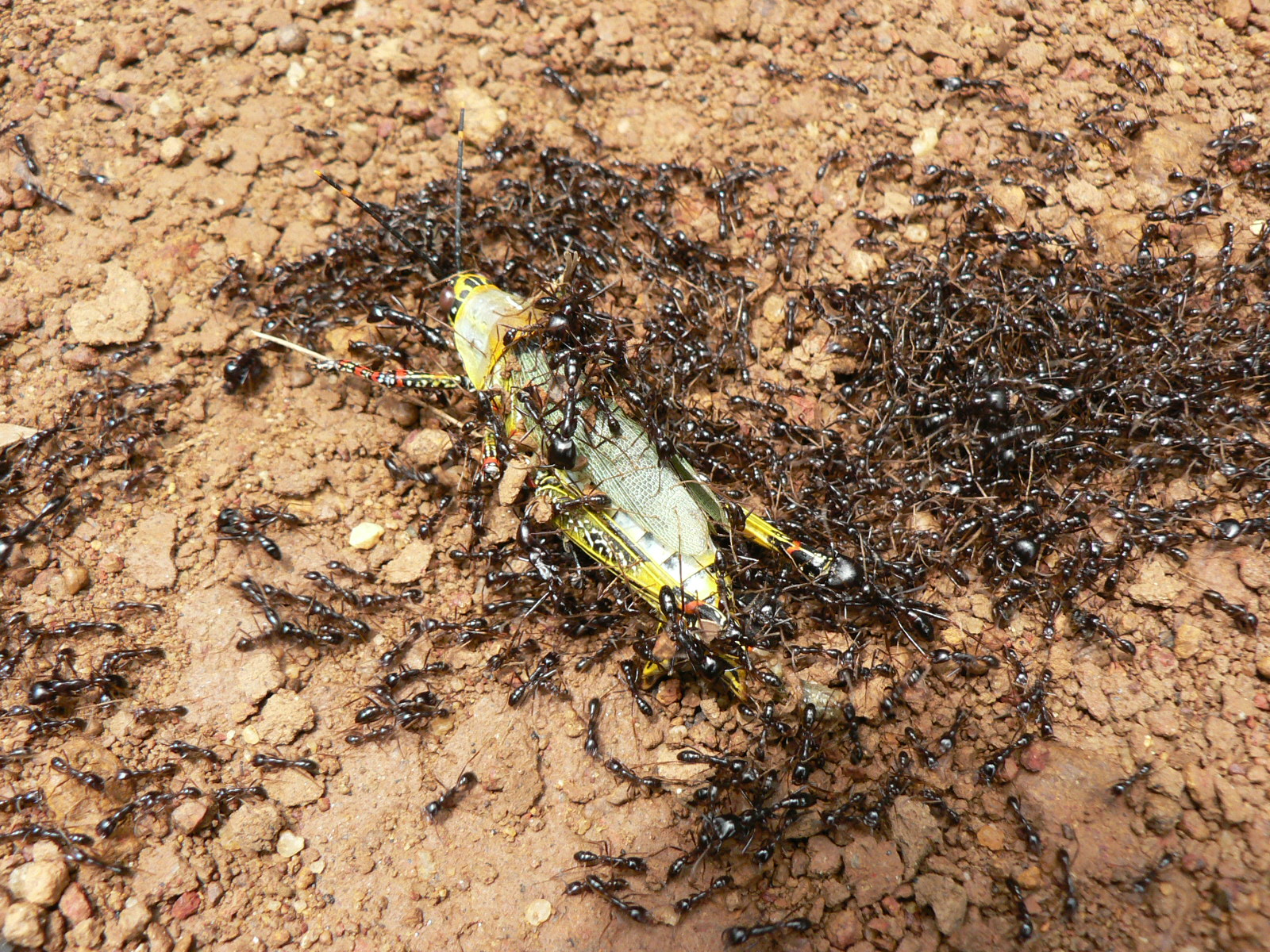
One type of army ant, those of the genus Dorylus, (seen above) are particularly dangerous. Native primarily to central and east Africa, armies of Dorylus ants can number up to 50,000,000 -- that'sa number 33% larger than the (human) population of California. By human standards, these columns move slowly, a mere twenty meters each hour, so in most cases, Dorylus are a significant nuisance -- but not much else. However, by sheer force of numbers, Dorylus have been known to overwhelm human victims too young or frail to move, causing suffocation and eventually, death.


Happy Feet LIVES!

Sunday, 2 January 2011


Some kids just get a little over excited when the snow begins to fall.  So it was with this little guy who - much to the bemusement of his penguin friends - just had to jump about and dance when the snow began to come down.

In the movie, Mumble was an outcast from his peers because he can't sing to save his life.  However, he is soon back in favor when he discovered his ability to dance. 

This little guy seems to have the same idea - except his friends seem to think that he is something of an idiot by their non-reaction!

Hey kid, don't worry what the rest of the world thinks - just enjoy yourself!

Make 2011 the Year of Cat Videos


2011 looks like it is already going to be a special year - at least in terms of cat videos!  This special plea by YouTube user joskows (that's his cat name, his real name is Jonah Oskow) can hardly fall on deaf ears - can it?  Last year the human race collectively created a paltry 5 million cat videos.  That really isn't an adequate number, now, is it?

We must take up our video cameras, film our feline friends in to infinity (and beyond) and post up the results to whatever social networking and media sites that we can possibly think of!

So hurry!  Let's make 2011 the year when cat videos took over the internet!


(OK, whose tongue, whose cheek?  But we laughed anyway!).

Bah Ram Ewe Sheep

Monday, 8 November 2010

Brenda Nelson did something of which a lot of us dream but rarely do.  She moved from the city to the countryside and now lives on a farm, pretty much living the life.  I have been following her online activities for some years but she has recently set up a new blog which I am sure will be of interest to readers of Ark in Space.

It is called Bah Ram Ewe Sheep.  Can you guess what it might be about?  Yes, that’s right!  Anything and everything on the upkeep of sheep.  On the site you will be able to follow the sheep experiences of Brenda and her family and share information about sheep in general.  Brenda keeps pet sheep and llamas and there are plenty of pictures on the blog too.

This promises to be a really cool online experience as you follow the seasons and get to know the sheep as individuals.

Birds on the Wires

Saturday, 18 September 2010


One day Jarbas Agnelli was reading his newspaper when he saw a picture of birds on electric wires which immediately fascinated him.. He noticed that the positions of the birds looked like a pice of musical notation.  He set about recreating the melody based on where the birds were perched.

He contacted the photographer who had taken the original picture who was also intrigued by the music.  He informed his Editor and the whole idea was turned in to a story in the newspaper.  Agnelli, spurred on, then created this animation with the photo, the music and the score.

There is absolutely no Photoshop involved here - the melody is created from the exact positions of the birds on the wires.  It's a lovely little tune, too!

Baby Wolf Spiders

Thursday, 16 September 2010


The maker of this video, Vimeo user Byron caught several adult wolf spiders and was taking care of them and studying them. Two of the spiders produced egg cases and carried them around with them for several weeks, even constructing little web-nests where the mother and egg case would sit, motionless, protected from the world.

Sadly, the mother spiders died, leaving their egg cases behind for Byron to take care of. Normally, the mother spider will open up the egg case and let the spiderlings out when they are ready to hatch; so after three weeks Byron opened them with tweezers  and the baby spiders jumped out!

Wolf spiders are unique among spiders in that they provide parental care: the spiderlings will jump on the mother's back and ride on top of her for a week.... if one falls off, the mother will wait until it jumps back on again.

Bedbugs: The Baleful Biters are Booming

Sunday, 12 September 2010

Apologies beforehand if you end up itching like a mad thing by the time you finish reading this.  However, bedbugs, which were once thought to have been almost eradicated are enjoying a massive bug renaissance. With the invention of DDT in the 1940s it was thought that the itch and rash would become a thing of the past. Yet like a scratch that you just can’t itch the humble bedbug has made an enormous comeback.

Above is a bedbug ingesting its meal of blood from a human host. What can only be described as an epidemic has broken out in the United States and, where the US goes the UK follows. The bedbug population of the United Kingdom is now booming. In both countries the problem is at is greatest since the Second World War. If you are getting freaked out by the site of one, screw your courage to the sticking point now.

Now the National Pest Management Association in Kentucky is predicting nothing less than a worldwide pandemic of Cimex lectularius. Yet how do they get in to your bed in the first place? They are not like that other blood sucker – the vampire: they do not have to ask permission to enter your home.

Plus, when they are doing it like they do it on Discovery Channel, it doesn't make them any more attractive. Their usual route in to your domicile is through luggage and clothing and often second-hand furniture. Unfortunately the cleanliness of your home is not a barrier – they often move from the Smiths to the Jones via cavities in the walls and floors.

An infestation from a distance can look bad - but not the end of the world.

Take a closer look though and it looks like the aftermath of a battle of Klendathu.

Then they feed on your blood, like the nymph above.  In fact, you can see the blood filling up and swelling its abdomen. You usually don’t feel a thing because they inject an anesthetic so you don’t notice and swat them. So that they can suck to their hearts content they also inject an anti-clotting agent – which keeps the blood flowing nicely.

If you are bitten too often it can create a rash or even eczema. As they like to stay close to their source of food – you – they can be found usually in the seams of mattresses and on furniture around your bed. Often they will live on the headboard, ready to jump you once you fall asleep. The bites are notoriously difficult to diagnose as they look like any number of things.


They are not nocturnal as such but that is when they are most active. When you fall asleep the warmth that you produce as well as the carbon dioxide from your breath attracts them like moths to the proverbial. However, there is some good news – they do not carry disease. So if you wake up one morning with enormous buboes under your arm it is most likely another source.

The females can lay hundreds of eggs, usually at the rate of one or two a day and they can live a long time between a feed, which means you can’t just abandon a bed for a year and then return to it thinking they will be gone. They won’t be. Here is what National Geographic have to say about the issue.


Scientists are not sure why they are making a comeback now. It could be the increase in international travel but it may also be that they have become resistant to the pesticides used to kill them. Whatever the reason, try not and let the bedbugs bite.

Dogs on Logs

Wednesday, 8 September 2010

Dogs on logs? There may seem little point to a series of pictures of dogs atop big pieces of wood - but perhaps that is exactly the point. And why not? Cats at least have the lol variety - dogs seem a little left out. Above, Pio has spotted something in the water.  Is it a fish?  Who can say but we can perhaps guess what happened next... So - over to the rest of our canine buddies.

Some dogs will look cute anywhere, but add a log in to the mix and the cute factor goes stratospheric.  Although Hula doesn't look terribly happy on the log you can rest assured he was helped safely back to the ground!

From the sublime to, well - make up your own mind.  Hula may not known quite what to do with his log (stay on it or run!) and neither, we suspect, does Killer.  However, he certainly looks immensely happy to have found it though (we will take a look at what dogs do to logs, once they have discovered them, a little later...).

Sydney does the two log tree (although one, long as it is, hardly qualifies as a log, but...).  What is it with dogs, logs and water?  Well, nine out of ten for effort, Sydney! I wonder if he knows that properly trained, a man can be dog's best friend?

Matilda is quite happy to keep her feet dry but if a log is there it does have to be climbed - simply because it is there.  Some say that dogs laugh, but with their tail.  That being said - isn't that a huge grin on Matilda's face?  If not - how would you describe it?

No, Libby we said dogs on logs not dog logs on. Always has to be one....

This young pup gets the two log trick right first time and shows up his elders at a young age.  Wait, though, where's the water?  Disqualified!

Jasper is a canny character though - logs have their uses on those long summer walks. Plus, he can be quietly smug about the fact that four legs are better than two by going where most humans would not tread.

Sometimes, though, speed can be of the essence.

Other times, just being still is best.  Cooper knows a good photo opportunity when he see one.  Some people says that on occasion dogs are almost human (although if they could talk, wouldn't that take some of the fun out of sharing your life with one?).  However, that could be classified as something of an insult.

Clear off!  You don't count!

That's better - even though in the case of Marla here, we might still have to play guess the species...

Dogs can get very possessive about their logs.  Whenever they see one, they get all mine, mine, mine.  The size of the log is irrelevant.  Ownership is everything.

Really, really possessive.

So, why this fascination with logs?  Well, that's not rocket science.  After all, dogs love to...

...chew....

..and chew.....


...and chew!

Allow the use of cookies in this browser?

Ark In Space uses cookies from Google to deliver its services and to analyse traffic. Learn more about cookies and how they are used.
Allow cookies Cookies settings