The page cannot be found

Possible causes:


  • Baptist explanation: There must be sin in your life. Everyone else opened it fine.
  • Presbyterian explanation: It's not God's will for you to open this link.
  • Word of Faith explanation: You lack the faith to open this link. Your negative words have prevented you from realizing this link's fulfillment.
  • Charismatic explanation: Thou art loosed! Be commanded to OPEN!
  • Unitarian explanation: All links are equal, so if this link doesn't work for you, feel free to experiment with other links that might bring you joy and fulfillment.
  • Buddhist explanation: .........................
  • Episcopalian explanation: Are you saying you have something against homosexuals?
  • Christian Science explanation: There really is no link.
  • Atheist explanation: The only reason you think this link exists is because you needed to invent it.
  • Church counselor's explanation: And what did you feel when the link would not open?

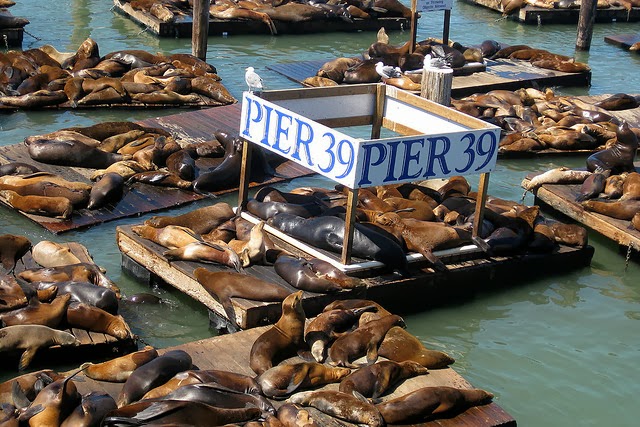
Sea Lebrities: The Sea Lions of Pier 39

Wednesday, 12 November 2025

We often read about people taking over the natural habitat of other species but it is rare to come across a case where the animals come back and reclaim their territory from us.  Yet this is exactly what has happened in San Francisco.  Local Californian Sea Lions have always been present in the city’s bay but had been pushed out to Seal Rocks, a small formation at the north end of the Ocean Beach.  Pier 39’s K-Dock was developed and opened in 1978.  Little did we know that the sea lions also had their eyes on this particular piece of seaside real estate.

They bided their time but their opportunity to move in (or back, if you argue that their presence along the Californian coastline predates human occupation by tens of thousands of years) came just over a decade later in 1989.  It was then that it was decided that the docks needed refurbishment.  In order to facilitate this all the boats had to be removed from Pier 39.  This left large open spaces inside the Bay.  A small number of sea lions saw their opportunity.  They metaphorically weighed anchor from the stony slopes of Seal Rocks and began to arrive at Pier 39.

Planet of the Lemurs: 10 Beautiful Little-Known Species

Most people have heard of the Ring-tailed Lemur (above) and could suppose that it is the only species. However, there are many varieties of Lemur, a lot of which are beautiful and incredibly rare. Take a look in to the planet of the lemurs and discover for yourself the wonderful diversity of this lesser known family of animals. Image Credit Flickr User Tambako the Jaguar

The Red-ruffed Lemur
This exquisitely colored species is critically endangered and part of its habitat in Madagascar has recently been made in to a National Park. This may at least ensure the survival of some of the species but as it is unable to tell where it is safe for itself, many of the animals live outside the park’s boundaries and are still prey to humans as ‘bush food’. Who could possibly bring themselves to eat this delightful animal in the full knowledge that it is nearing extinction?

What do You Have to do to Get a Drink Around Here?

Monday, 4 August 2025

Water! From a purely biological point of view water has a number of properties that are paramount for the proliferation of life on this – or any other – planet. Its life giving and sustaining properties is what sets it apart from all other substances.

From the largest mammal to the tiniest insect we all have to drink. If we don’t we die. Here, we focus on the little guys, the ones which you can hardly imagine need much water. Indeed, sometimes they can be in danger of being carried away in their enthusiasm to sate their thirst. Thanks to some wonderfully macrophotography we get to see this most vital of functions being carried out – with some gusto – by a host of insects.

The Remarkable Giraffe Weevil of Madagascar

Friday, 16 August 2024

Three guesses how the giraffe weevil gets its name. Unsurprisingly, this extraordinary looking Madagascan creature gets the name from its stupendously long neck.  It is three times longer in the male than the female of the species (Trachelophorus giraffa). As such it is sexually dimorphic – the male’s neck is used for aggressive combat.

When it comes to mating, it is certainly the male of the species which is more deadly.  The giraffe weevil has evolved its extended neck to fight for the right to a nearby female (which will patiently await the outcome of the fight and even occasionally act as a kind of referee before procreating with the winner). They show no aggression towards other species, neither hunting nor eating other animals. It is rare for males to kill each other in this struggle.

The Strange Elegance of the Giraffe-Necked Antelope

Sunday, 9 April 2023

Found in Eastern Africa ranging from Somalia to Kenya there is a slightly odd looking long-necked creature that is reminiscent of a giraffe but that is one thing it most certainly is not.

The Darth Vader Ant with Superhero Gliding Skills

Sunday, 16 October 2022

Big head
Their skills eluded observation until early this century, but you can add another animal on to the list of those who have developed the ability to glide.  Joining snakes, squirrels, frogs and lizards with those superhero-like gliding skills is a species of ant. 

And what an Ant!  The Darth Vader of the insect world, Cephalotes atratus, inhabits the canopy of the tropical forest systems of Central and South America.  That’s a long way up and if an ant was to fall it would lead to almost certain death on the floor of the forest.  Either that or a trip that would make The Incredible Journey look like a walk in the park, but one which would probably be impossible due to the lack of chemical trails to guide the ant back home.

Unexpectedly Funny Things to do with Hamsters When You're Bored

Thursday, 28 October 2021

Hamsters – they’re adorable and surprisingly good company too. Here we take a look at some unexpectedly funny things you can do with hamsters when you’re bored – and throw in some cool facts about hamsters at the same time!

1. Amuse Him With Your Office Anecdotes
Hamsters love to hear what went on at the office. In fact they like nothing better than a long and intense monologue. Start with the time you got to work and give him a blow by blow account of the day’s activities. You can even tell him those secrets that you can’t tell anyone else, like who is having an affair with the boss. Hamsters love gossip!

Monarch Migration – Staggering Spectacle of Nature

Saturday, 19 June 2021


Monarch butterflies are renowned for their migration.  Yet no single monarch has ever completed the 2,000 mile round trip – it is generational in nature because of the sheer distance involved. There being safety in numbers this leads to what is surely one of nature’s most spectacular sights – that of millions of monarchs congregating together.

In North America the butterfly begins this massive yearly migration in August.  Monarch butterflies fuel up on nectar in the northern States and Canada - it is time to leave as the coming winter will be so cold it would inevitably kill them.  Unlike their great-grandparents they have never flown more than a few hundred meters in their lives but they head out over vast northern lakes with no hesitation.  This is the first leg of one of the world’s greatest migrations.

The Pronghorn – The American Almost Antelope


If you were asked to think of a large mammal of the American prairie you might well say the bison, coyote or wolf, a measure of how much these species have settled in to our general consciousness. Yet there is one unique American animal which is less known but is perhaps the most charismatic of the Great Plains. Many refer to it as an antelope but that is far from the truth. A true American native, the Pronghorn has sojourned across the deserts and plains of North America for at least a million years: but an antelope it is not. Its closest relative is the giraffe.

The pronghorn is found nowhere else in the world except the interior western and central north of America. At first sight it certainly does resemble the antelope of the Old World but it is thought to be a classic example of convergent evolution. This is where species develop to inhabit at least two separate places in the world but which share features and behaviors which mean they may resemble each other despite no shared ancestry. To the untrained eye, their appearance would suggest that they are related species even when they are not.

The Extraordinary Pink Katydid

Flamingos aside, you do not get to see the color pink in the animal kingdom a great deal.  A notable exception is the pink katydid.  Yet this is by no means a separate species – this coloring affects around one in 500.  You may have already guessed that the condition is something similar to albinism.

Known as erythrism, the condition causes a curious reddish pigmentation. It can affect the body of an insect as well as its skin, and it is so rare that it was not noticed by western scientists until 1887. The reason for this oversight was perhaps due to the inclination of the insect to remain perfectly still during daylight hours.

Meet the Black Squirrel

Sunday, 17 January 2021

You have probably seen the grey. You may even have encountered or at least heard of the red. However, have you ever seen a black squirrel? Take a look at this small but dark beasty of the forest.


This is the black squirrel. Out of the squirrel population of the United States and Canada perhaps only one in ten thousand is black. However, this is not a separate species in itself. It is in fact a sub-group of the grey squirrel and, little by little their numbers are growing. In fact in some areas they outnumber the greys. However, this black coloring is not a recent trend among the squirrel community – research indicates that in the days before the European settlement of the America the black squirrel was probably much more numerous than the grey. 
Image Credit Flickr User James Martin Phelps 

Instead of being a separate species, the black squirrel is in fact what is known as a melanistic subgroup. Midwestern North America is their stomping ground although there are groups to be found in the UK (more of which later). Melanism is caused by an increased level of black pigmentation, a compound which determines color called melanin. This subgroup of the Eastern Grey has stacks of melanin and these melanistic traits are the opposite of albinism which occurs when flora or fauna have a lack of the compound.

Great Egret Rising

Wednesday, 13 January 2021

With its all white plumage that can often reach a meter in height, the Great Egret is a sight to behold as it soars up in to the sky.  Considered safe, only a century ago the species was highly threatened. Read on to discover how and why the species was able to make a dramatic come back.

Dolphins in the Wild - Photo Special

Sunday, 20 September 2020

Dolphins – those special marine mammals – are the subject of this photo special.  All the pictures here are of wild dolphins, some of the almost forty species that are found worldwide.  They are a recent evolutionary adaptation, having first appeared on this ark in space around ten million years ago.  Intelligent, curious and fearless, they embody many of the qualities that we admire and to which we aspire. Welcome to the world of the dolphin - free, physical and wild.

The Biggest Dogs in the World - There Be Giants

Sunday, 24 March 2019


Let’s face it, some people like their pets big! If you are looking for a large dog there are a number of breeds which are generally referred to as giants. Be careful, though – you should only consider these breeds if you have lots of space, lots of time and quite a deal of money. The Ark in Space takes a look at the giants of the canine world.

The English Mastiff
The English Mastiff, in terms of mass is the big daddy of all dogs and its dimensions particularly that of the male are something to be believed. Every inch of this dog gives off strength and power – if the planet Krypton had a dog then this would probably be it. The world record holding breed for weight, this dog can weigh up to two hundred and fifty pounds for a male and around fifty pounds less than a female. The breed has been around for a long time – the name probably derives from the Anglo-Saxon word for powerful –masty. It is generally recognized to be the oldest dog breed in the UK.

Avian Architecture – the Precarious Nests of the Stork

Sunday, 3 February 2019

Storks make their nests high. To us they look remarkably precarious structures, not exactly a desirable residence – the ‘des res’ of your dreams. The stork, however, thrives at height most of us would avoid like the plague. Take a look at some amazing nests of the stork.

Although many Europeans encourage storks to nest on the roof of their home – it is supposed to increase the fecundity of the householders – many would gasp at the inherent danger that lies in building one’s home on top of a deadly current of electricity. In Denmark, however, the stork is not a welcome guest and so this would be considered appropriate alternative housing. The Danish believe that if a stork builds a nest on top of your house then someone who lives there will die before the year ends. These parent storks, however, will not be on the nest for great periods of time. This stork in Hungary is flying back to the nest to feed its offspring. The visit will need to be fairly quick though – stork chicks can eat anything up to sixty percent of their body weight each day. That is quite a few fish and frogs.

The Meerkat - Sun Angel of Africa

Saturday, 5 January 2019

The Meerkat – if any species of animal had a right to be a little irritated by the name we have gifted them, this is one. Of course, they are blithely unaware of any names we might choose to call them, but this small mammal from the heart of Africa is anything but a mere cat.

In praise of the Mutt

Sunday, 4 November 2018

Many people buy a dog as a status symbol and so go for a certain breed to mirror their own lifestyle. Still more have a particular attachment to the specific look and behavior of pure breeds. However, for personality, joie de vivre, unadulterated love and many other positive traits, can anything beat a good old fashioned mutt?

Why Cats Like Boxes So Much

Saturday, 14 July 2018

Cats like to hide.  That is because they employ something called crypsis to keep themselves safe and sound.  A cryptic animal, like a cat, uses its anatomy and behavior to hide from anything which might predate them. It is different from camouflage as this can also be employed by predators and is used by many animals, including big cats, to more effectively attack prey.  A house cat uses its natural flexibility to hide in places a predator might not consider. A box is just that. Inside it, a cat feels invisible, and that is exactly how he likes to feel.

Perhaps these exceptions don't quite prove the rule, but let's go with it.

The Pygmy Goat - Not So Gruff

Sunday, 19 March 2017

Who is the gruff looking buck above? There is something familiar about him but this is no standard goat, no sir. This is the pygmy version and as is a cousin of the variety we generally picture when the animal comes up in conversation. Welcome to the world of the pygmy goat.


Allow the use of cookies in this browser?

Ark In Space uses cookies from Google to deliver its services and to analyse traffic. Learn more about cookies and how they are used.
Allow cookies Cookies settings