Baptist explanation:
There
must be sin in your life. Everyone else opened it fine.
Presbyterian explanation:
It's
not God's will for you to open this link.
Word of Faith explanation:
You lack the faith to open this link. Your negative words have prevented
you from realizing this link's fulfillment.
Charismatic explanation:
Thou
art loosed! Be commanded to OPEN!
Unitarian explanation:
All
links are equal, so if this link doesn't work for you, feel free to
experiment with other links that might bring you joy and fulfillment.
Buddhist explanation:
.........................
Episcopalian explanation:
Are you saying you have something against homosexuals?
Christian Science explanation:
There
really is no link.
Atheist explanation:
The only
reason you think this link exists is because you needed to invent it.
Church counselor's explanation:
And what did you feel when the link would not open?
It is little wonder that many movie monster makers look to the alien world of insects for their inspiration. Here, with the aid of some amazing macrophotography, get up close and impersonal with some strange species that might not look too out of place in a sci-fi movie.
There are around ninety species of beetle backed flies – and this is one of them. Native to Asia and Africa they do are small sized insects but with macrophotography they do not look quite so small. The reason for its swollen appearance is not because it is about to lay eggs (or has just ingested something larger than itself which is enough to start off a gag reflex, possibly). Rather it has an enlarged scutellum. This is the triangular plate behind its pronotum, which is one of the three parts that makes up its thorax. Its wings are behind the scutellum.
Around 800,000 years ago a species developed on the African Savannah, a canid but quite unlike any other. It was small – with a head and body length of only around 55 cm, tawny furred and with black ears. It is the ears which really make this mostly nocturnal animal stand out. On average they are a staggering 14 centimeters in length. Proportionally they may not be as large as Dumbo’s but this is no fictional appendage. These ears are for real.
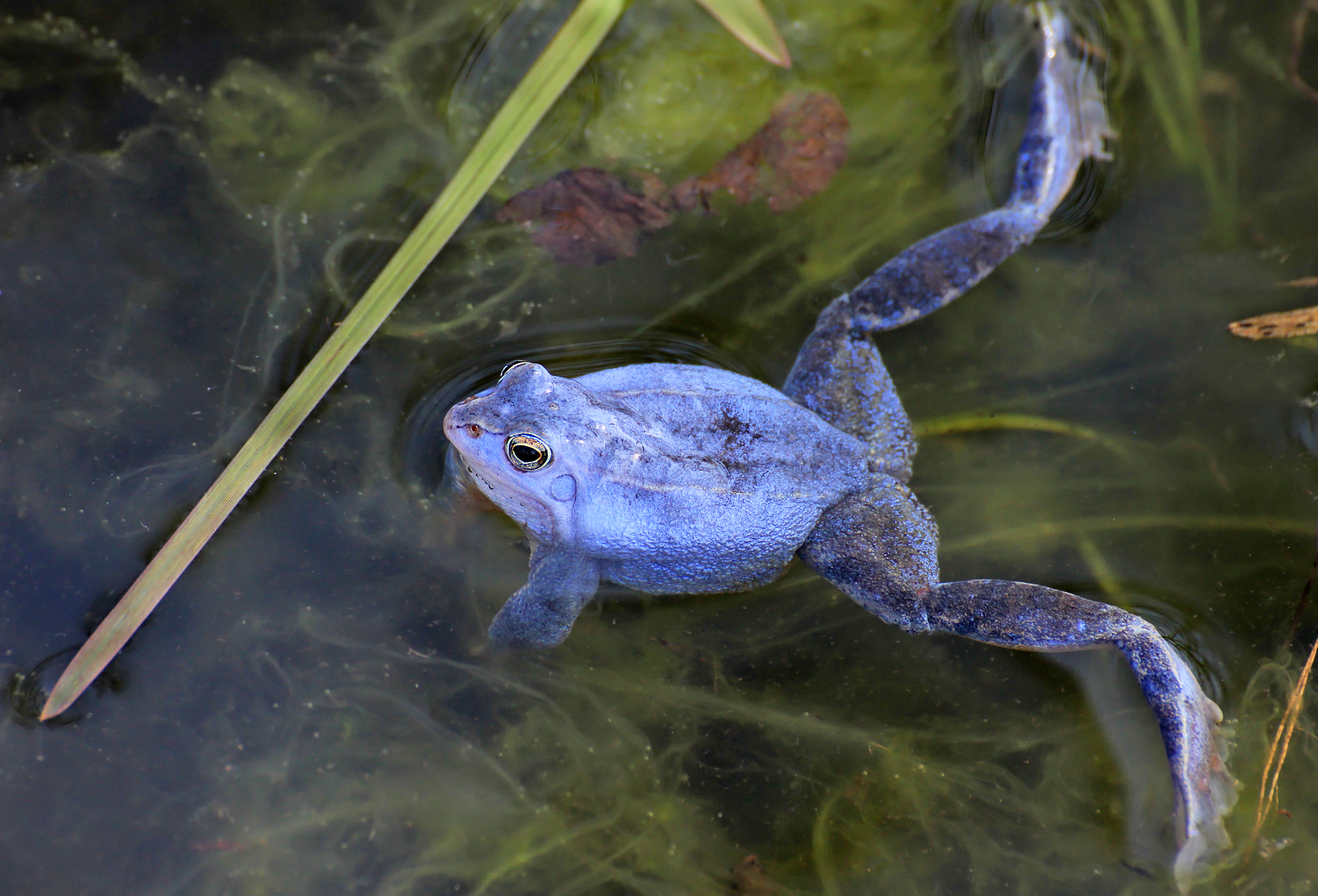
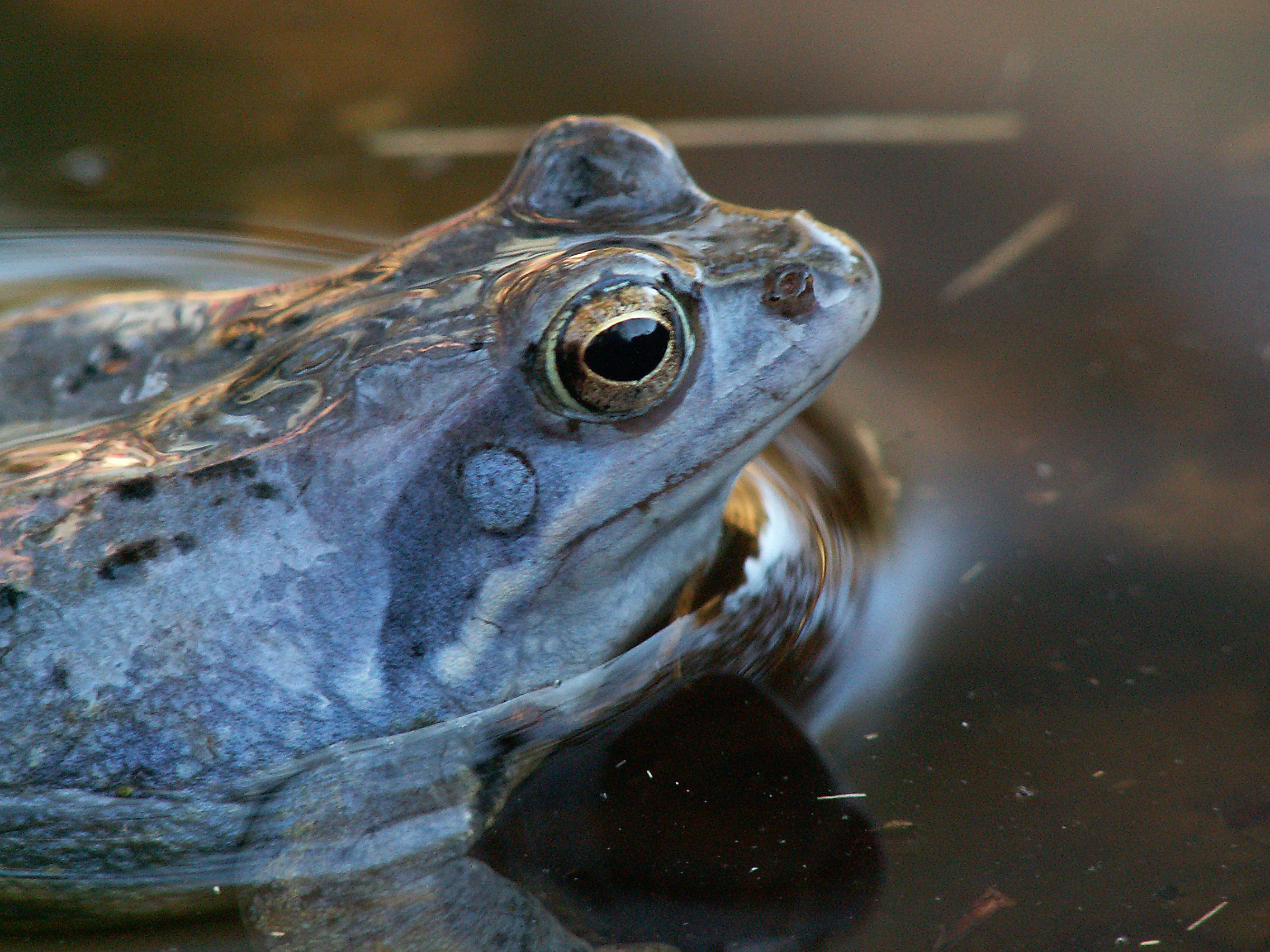
The Moor Frog is a small and rather unprepossessing amphibian. They grow up to seven centimeters in length and are a reddish-brown color. However, all that changes once a year between March and June. It is then that the male of the species turns blue.
Dumbo famously featured pink elephants, but did you know that there was a pink dolphin? In their wild habitat of the Amazon River they are quite happy to meet and greet those willing to forego a few fish for the pleasure of their company.
This is the story of a tiny insect smaller than a grain of rice – in a way it’s the circle of life writ very, very small. A native of North America, the species has recently been having something of a feast and the mountain pine beetle has reproduced to plague proportions. They have now killed most of the mature pine trees in an area the size of Wyoming. The people at the Ruckelshaus Institute guide us through the story and the possible future of the mountain pine beetle.
This alligator in Florida was captured on camera by Flickr user Marc Barrison. While we should really - at all costs - avoid anthropomorphism, when you see a picture of an alligator with flowers on its head its is really hard to resist the temptation. It might be hard to take an apex predator seriously with such a pretty bonnet but I would imagine that if it chose to lunge - flowers or no - we might not be the ones having the last laugh!
Don’t be fooled by the off the scale cuteness quotient. This is the Sand Cat – or Felis margarita, a little known species of desert cat. In the wild it lives in areas that are too hot and dry for any other cat- the deserts of Africa and Asia, including the Sahara. It is the only desert species of cat known to us. As such, this cat is one tough cookie.
It also lives in the Arabian desert and those of Iran and Pakistan, yet despite being so widespread it was not described by a European until 1858. That happened to be one Victor Loche, a French soldier and naturalist who explored the Northern Sahara and found the sand cat waiting patiently there for his descriptive skills.
Meanwhile, over in Africa, a critically endangered species of frog has caught the world’s attention. Endemic to just a 10 kilometer stretch between the countries of South Africa and Namibia, this small amphibian does not croak or rivvit – it squeaks. Play the video above to see for yourself. It sounds just like one of those squeaky toys you might give a dog to play with.
Squeaking aside for the moment, the Latin name for the desert rain frog is Berviceps macrops and it lives on a narrow strip of sandy shore between the sea and the dunes. It lives mostly under the ground but when the fog drifts in from the ocean it takes to the surface and emits its war cry. This may be enough to frighten off others of its species but it has become a long-lived meme on the internet.
Fortunately, it’s unlikely that many will venture to its sandy habitat to steal specimens. Yet its environment is threatened both by industry and encroaching human populations. It is difficult to find as it is nocturnal – even though it leaves behind it very distinctive ‘foot’ prints. These are usually discovered around heaps of animal dung – the frog is thought to live off the small insects which congregate around this matter.
It seems it is the misty air which keeps the frog’s skin moist – the areas where it is found get over 100 foggy days each year. There are no pools for tadpoles, however; the young are laid under the ground and emerge at the surface as fully-formed if tiny desert rain frogs. When they are seen above ground, they often have sand stuck to their skin.
Perhaps that’s why they get so angry. It isn’t known really whether this is a warning, a mating song or something else. One can only hope that the desert rain frog continues to squeak its way through the millennia despite our best efforts to destroy its habitat.
There are millions of species on the planet, right? So, surely we can spare a few of them! Directed by Luis Navarro for Divulagare, this animated short documentary takes four minutes to explain very clearly why the conservation of our planet’s biodiversity is of paramount importance to us all. Think of an ecological butterfly effect and you (ort of) get the picture. Enough of me trying to explain – press play!
Australia is home to many strange and unusual animals, something the majority of us know. When asked, most people would say that it is the marsupials of the country that are the most significantly different to the rest of the world. Perhaps that assumption should be questioned – Australia is also home to the tiny Peacock Spider, whose behaviour and appearance is nothing short of startling.
Animals fight for a variety of reasons. It may be for play, for space or, most likely, for sexual dominance. Here, with the help of some wonderful images – we take a look at a few species in the throes of fighting.
A pair of gulls fight in mid-air. Conflict is incredibly commonplace within the animal kingdom. Quite often the fights are short and based on display rather than actual physical contact and so it is difficult to capture on film. The photographer must be incredibly quick in order to get that photograph. This particular spat, for example, would have been over in seconds.
This somewhat strange looking specimen is a Sand dollar. It is a sea urchin which burrows and comes from the order Clypeasteroida – and you can see why it gets its name, as it resembles a coin. Some joke that it is the only stable dollar in the world at the moment. Humor aside, it does have one trick up its sleeve that we can only wish would apply to real money. It can clone itself – creating a perfect copy.
Madagascar is an amazing place and here Lance Featherstone has captured its wildlife wonderfully. I don’t know about you but sometimes music can enhance a video about the natural world but most of the time I find it a distraction. However, what Lance has decided to do here is to keep the natural sound of the rainforest as the backdrop to his film. It works beautifully and one is left with a sense of the peace of the place.
If you have ever gawped at the sight of a dragonfly whizzing past you in all its colorful aerodynamic glory, then you will enjoy this film immensely. It has some of the best macrophotography of the dragonfly in all its stages that I have ever seen. Plus it answers all the questions you might have about the life cycle of this ancient creature which has survived virtually unchanged for millions of years.
However, the part that I found most fascinating was the part of the film which describes how dragonflies live most of their lives as nymphs and that a number of different species can live side by side during this stage (even though they don’t mind the off foray in to cannibalism).
One thing I certainly did not know is that during this period of their lives they have a lower jaw which they can extend suddenly and swiftly, like a hydraulic ramp, to catch prey that would otherwise be just out of their reach. It is quite a sight.
The amazing facts about dragonflies do not stop there and after they come in to their brief adult phase each species seems to have its own interesting variation on the mating game. The documentary takes us throughout the year to the inevitable demise of the adults. However, below the placid waters of British ponds a vicious fight for survival continues.
Created by Andy Holt of Wild Life Lens, Dragonfly has been awarded Best Documentary at the BIAFF (British International Amateur Film Festival) 2014 Film Festival.
Many species of birds possess crest feathers and this feature dates back to the age of the dinosaur: the fossil record indicates that a number of species had feathers on their heads. You might think that they are for display purposes – and you would not be wrong although their function is sometimes more complex than that. However, some birds take this avian attribute to the extreme. The results are striking and beautiful. We present the Ark in Space’s Top Ten Crest Feathered Birds.
Over to Africa where we find the White-crested helmetshrike – the name says it all really. What makes this bird even more striking is the vivid yellow periophthalmic ring (the protective circle of bare skin) around its eye. It is a very sociable bird and moves around in small social groups. You can always tell when you are close to a party of WCHs – they chat to each other very noisily.
There are a number of theories why there are so many rabbits on the Japanese island of Okunoshima but the fact remains that the place is pretty much overrun with them. Here, Krzysztof Gonciarz and Kasia Mecinski, take a look at the island and the dichotomy of having these Cunicular bundles of fun right next to an old poison gas production plant. If you like rabbits this place must be on your bucket list.
The New Forest of England is an ancient world full of medieval monsters - duelling dragonflies, acid-firing ants and jousting stag beetles. Filmmaker Oliver Mueller combined macro, slow-motion and time-lapse techniques were combined with custom-built equipment to reveal these astonishing lives. The film was the result of 30 days shooting on location during the summer of 2015, plus months of research, planning and post-production
I have always loved London’s Horniman Museum since my first visit there over twenty years ago. It’s quirky and I mean that as a compliment. The museum has just opened a charming new addition, building on its reputation for small but wonderful exhibits. The new permanent Butterfly House, which will be open 362 days per year, is a pleasure to visit and complements the museum’s other features (exhibitions, events and gardens) perfectly.
On entry to the exhibit, the member of staff on duty takes care to explain a few simple rules to follow once inside – such as be careful where you walk as butterflies land wherever their fancy takes them and are oblivious to the potential squishing they might get at the hands of careless feet (if you see what I mean!). Moreover, we were gently told that touching the butterflies (and the plants, some of which may cause irritation) was not to happen. The same rule does not apply to the butterflies, however – during our time in the house there were several landings on heads, shoulders, legs and various other parts of the body. However, if they don’t fly off within a reasonable period of time, a friendly member of staff is always there to give the butterfly some gentle encouragement.
Scotland is a stronghold for the red squirrel: its numbers in the UK were decimated by the introduction, around a century ago, of grey squirrels from North America. Larger and more aggressive, the Americans soon took over most of the red squirrels’ habitat. Yet in some parts of Scotland there are no squirrels at all – a result of land clearance – squirrels do not travel well when there is no tree cover. So, Trees for Life have started the process of populating ten sites in the Scottish highlands with red squirrels using members of existing populations and moving them to their new home. This fascinating short film by the Wild Media Foundation follows the journey of four red squirrels as they become pioneers for their species in a new habitat.
Allow the use of cookies in this browser?
Ark In Space uses cookies from Google to deliver its services and to analyse traffic. Learn more about cookies and how they are used.