Baptist explanation:
There
must be sin in your life. Everyone else opened it fine.
Presbyterian explanation:
It's
not God's will for you to open this link.
Word of Faith explanation:
You lack the faith to open this link. Your negative words have prevented
you from realizing this link's fulfillment.
Charismatic explanation:
Thou
art loosed! Be commanded to OPEN!
Unitarian explanation:
All
links are equal, so if this link doesn't work for you, feel free to
experiment with other links that might bring you joy and fulfillment.
Buddhist explanation:
.........................
Episcopalian explanation:
Are you saying you have something against homosexuals?
Christian Science explanation:
There
really is no link.
Atheist explanation:
The only
reason you think this link exists is because you needed to invent it.
Church counselor's explanation:
And what did you feel when the link would not open?
Look up at the sky and what do you see? Well, blue, yes. And maybe a plane or a bird, but otherwise ... nothing. Or so you think. It turns out that right above you, totally invisible, is an enormous herd of animal life -- tiny bugs riding the wind currents.
According to research done by British scientists in a six mile square space about our heads there can be as many as three billion insects.
That is quite some figure. This amazing animation takes you through the reasons why. Some of the heights that these insects reach is pretty spectacular to say the very least. It certainly answers the question how high can insects fly?
Take a look at the photograph above. Is it some strange kind of blooming plant? Is it a fungal growth attached to a tree? It is something else entirely. This is the bizarre nest of the Central American Paper Wasp (Apoica pallens). It is notable for one thing – an apparent lack of nest altogether. Those pale yellow cigar-shaped objects? They are the wasps, huddled together in neat order, waiting for the evening to come.
Image Credit
The species is native to the lowlands of central and northern South America, so unless you live there you are not going to stumble across something like this in the forest – although whether that is a shame or a relief entirely depends on you. However, these wasps have developed a kind of night vision which means that they swarm and forage only after the sun goes down. Until then, they adopt this position under the comb face of their nest – and it is entirely defensive.
It is less than a centimeter in length and that is something for which, quite possibly, we can be truly grateful! This assassin bug, found in Malaysia, has a trick up its sleeve once it has finished its dinner. It attaches the empty carcases of its victims on its back – a ploy thought to be an attempt to avoid becoming a victim itself.
The nudibranch is a soft bodied marine gastropod mollusk – but many people simply refer to them, perhaps somewhat unfairly, as sea slugs. You can see why they gained this nick name (even though it is often taxonomically inaccurate too!) but compared to the land bound version they are an explosion of color and grace. Here are just a few of the 3,000 species. (Image Credit Flickr User CW Ye)
This beautiful creature is found in the Western Pacific. A rich pinkinsh purple color, they have a white border on their mantle. They would be startling enough without, but their rhinophore clubs are an orange-yellow color that is a startling juxtaposition with the rest of their bodies. This exquisite creature is formally known as Hypselodoris apolegma.
It was not so long ago that naturalists were predicting that the Water Vole would be extinct in the United Kingdom within a few years. Predation by the North American Mink, loss of habitat and pollution seemed to be the main culprits.
The much loved small mammal, immortalized in fiction as Ratty (left) in Kenneth Grahame’s Wind in the Willows, seemed destined for the history books. It was given protected status as late as 2008 - a legislative moved considered by many to be too little too late.
Yet just a few years after their dire predictions it seems that the water vole is back from the brink, testimony to the help it has received from conservationists.
Thriving colonies of over two thousand now exist in several places in the UK. Less than ten years ago, surveys of the same places revealed only a scattering of water voles, less than twenty in each location. If those numbers have made you raise an eyebrow you may not know just how fecund a water vole can be. Left to her own devices a female can produce up to thirty young in a season with up to eight baby voles per litter. So, what did the environmentalists do to aid such a dramatic come back for this semi-aquatic rodent?
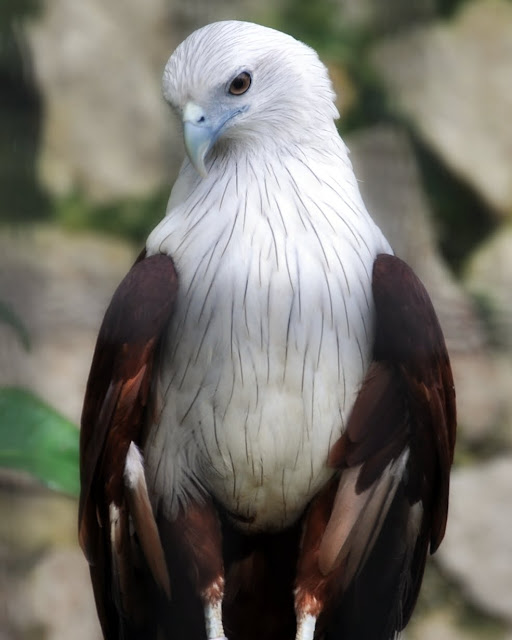
The National Bird of two countries - Zimbabwe and Zambia – the African Fish Eagle is a bird that, with its gorgeous snow white head, once seen is never forgotten.
The Eagle is found in most parts of the continent – as long as you are south of the edge of the Sahara Desert. Also known as the African Sea Eagle it is found anywhere near where there is water containing fish. It has a distinctive call which immediately identifies it, but what really stands out is its magnificent plumage.
Perhaps it is the mucus, perhaps the snake-like appearance or the habit of many species of slug to regard your garden and the carefully cultivated plants within as dinner – but the slug generally has a pretty bad press.
So, if you just groaned in horror at the picture above, you are in good company. A lot of people don’t like slugs. The sight of them in a garden has been known to turn even the most mild mannered in to mad mollusk murderers. Yet the giant Banana Slug, the second largest in the world (after the European Limax), has more than just its size and resemblance to a certain yellow fruit as a claim to fame. This is one of the unsung champions of the forest, for the banana slug only eats dead organic material which they then turn in to soil.
Imagine you are an insect caught in a spider web. What exactly will happen to you once the spider comes and, as it were, sits down beside you? It’s not a pretty process, that’s for sure but some amazing macrophotography can make even death a thing of beauty...
The fate of a creature caught in a spider web often holds a morbid fascination to the casual viewer. The urge to release them may be strong but many hold back, perhaps afraid that if they assist the struggling animal then a similar fate may well be in store for them.
The lizard that looks an awful lot like a certain superhero is in huge demand in pet shops. Take a look and find out why.
Fans of Peter Parker’s erstwhile alter ego Spider-Man who also happen to be animal lovers have discovered their ideal pet.
Looking strangely like the comic and movie hero, step forward the Mwanza flat-headed rock agama. Yet if you suddenly want to run out and buy one, you need to consider the facts first of all.
It is partnership between man and animal which has lasted over a millennia. A fisherman needs to catch enough fish to sell and feed himself and his family. Sometimes that means that he needs an assistant. Along the river ways of China that assistance has come from a member of the pelicaniformes order of birds – the bird we call the cormorant.
These are working animals in much the same way as dogs and horses on farms in the west with a specific role assigned to them. The major primary difference is that the cormorants are not born in to captivity. They are lured by bait and caught. The training process can then begin.
Did you know that the UK has over 250 species of bees and that the majority of them don’t live in hives but live their lives alone? This wonderful documentary by Team Candiru follows first Red Mason Bees and then others as they struggle to find resources, avoid death and create new life. If you love nature the next seventeen minutes are going to seem like a few seconds. Enjoy!
Plus if you want to learn more about the bee hotels included in this documentary then whey not visit our feature article on them?
When the floods hit Pakistan in 2010 the first thing that many people did was to head for higher ground. So too did countless millions of animals, among them spiders. To escape the rapidly rising waters the spiders did the sensible thing and climbed up trees.
The flood waters took quite a while to recede. The result was that the temporary arachnid shelter became semi-permanent – and a spider has to do what a spider has to do...
There are a number of things which separate the burrowing owl from other species. The first clue is in the name. Another is that they are the smallest species of owl on the planet and more often or not they do not weight more than half a pound in weight and reach around ten inches in height. They also come out in the day time, unlike most other owls.
That is not a snake that the adult burrowing owl is feeding to its chick. It's a caterpillar - which goes to show just how small they are. They are also much more relaxed around humans than other species of owls. They will happily colonize areas like airports and golf courses and have even been known to nest in larger gardens. As long as there are open areas and a good water supply they seem to be content to live near us.
Cephalotes is a broad genus of ants. They are heavily armored – it makes you wonder just how formidable they would look if we were the same size. The amazing thing about many of them is the head – used to plug a gap as it were. Above is an ant of the species Cephalotes varians.
Earth is home to an immense variety of living beings and animals, many with qualities which make them very rare and special. If you go looking, you will come across all kinds of insects, fish, birds and mammals which will fascinate you, and sometimes even make you shiver with fear.
In fact, the mankind’s relationship with such species goes back thousands of years. Many of these animals whom we consider exotic today used to be pets for our ancestors. To tell you the truth, there are some exotic animals which people still actually keep in their homes. Regardless, let’s acquaint you with the four most exotic animals that mankind has ever come across.
Mandarin Duck
Found in Russia, Japan and China, Mandarin Duck was first introduced in Europe and is considered exotic because of its immense beauty. The male duck has a phenomenal variety of colours like orange, fuchsia, cream, brown, blue and green. These ducks normally inhabit in areas close to lagoons, ponds and lakes. Having them in the vicinity is considered good luck in various parts of Asia. Many also consider their presence as a mark of conjugal love and affection. In some countries people also offer Mandarin Duck as a gift to the groom/bride during weddings!
Slow Loris
A primate that is found mainly in Asia, Slow Loris is a sort of Internet celebrity. The evolutionary history of this animal remains a mystery. What sets it apart is the way it protects itself from the predators. It has a gland in its armpits which possesses poison and becomes active whenever it licks that area. The female Slow Loris even apply this poison as a coating on their young ones to protect them. Apart from the deforestation problem, this species is threatened with extinction by none other than the human beings. You can often find people involved in illegal trade of this small mammal in the underground market.
Pink Grasshopper
You must have seen green, brown and sometimes even the white grasshoppers. But Pink grasshoppers are a rarity as they are a result of a recessive gene which is not found in majority of the species. There is only one in 50,000 grasshoppers which has this colour. As is evident, the exotic nature of this species is because of its colour, which also makes it unattractive to its predators.
Pangolin
Image Credit
It’s a kind of mammal which has large scales and is found in the tropical regions of Africa and Asia. Although pangolin doesn’t have any specific body weapon which it can use against its predators, its legs are so powerful that it can dig the ground very quickly. Such is the force of its legs that it can even break the human leg with one hit.
The Pangolin wards off its predators by emitting a very foul smell or by digging quick holes into the ground. You will find them living in pairs or alone. It’s not uncommon to find Pangolin meat in China as there is excessive demand for it in the country.
Picture one of those double-take moments when you have to look again in a mixture of curiosity and alarm. Then imagine that you are thirty meters underwater when that happens. Over the years, divers off the coast of California have had many such moments when they suddenly come across the huge face of an old man peering at them from the rocky reefs below. Yet this is not anything approaching a subaquatic nightmare: it is the face of an extraordinary creature, the wolf eel.
Do you see something a little strange about the deer in the picture? If your eyes were immediately drawn to those rather vampiric fangs protruding from its mouth, then your next thought might have been that this must be some sort of freak of nature, an accident of birth. That isn’t how deers come, is it? For the Water Deer, otherwise and popularly known as the Vampire Deer the answer is in the affirmative.
Let’s give the animal its proper name. This is the Chinese Water Deer (Hydropotes inermis inermis) and it is one of two subspecies (the other being the Korean variety) which have prominent tusks, downward-pointing canine teeth which make it look as if it’s had a run in with a Nosferatu type who has suddenly acquired the ability to ‘turn’ mammals other than humans. This feature makes the subspecies unique – they are the only two members of the genus Hydropotes.
Small hermit and soldier crabs in Malaysia and Australia build their home digging a deep hope in the sand on a beach. They got a good idea of how to move sand up during his construction. Down in the hole this crab is making sand balls and later push them up to the surface, 2-3 balls at a time. Pushing sand ball more far from the hole they form a kind of sand ball flower or sand ball galaxy.
Let’s face it, if you are as sharp and curious as the average goat then life in the farmyard could become just a little bit dull. However, when a flexible steel ribbon is placed inside your pen for no apparent reason then a use for it just has to be sound.
This video shows that just like most other living things on this wonderful planet of ours, goats just wanna have fun.
Play Golf? Well perhaps not quite as we know it! This young bear and other members of his family were spotted on the Mountainside Golf Course at Fairmont Hot Springs Resort in Canada.
Andi Dzilums was out on the course that morning and managed to capture the moment that the bear cub took the inevitable decision to grab hold of and run around (and around!) with the pin. This amusing spectacle of bear-faced cheek (couldn’t resist it) carried on until the cub spotted something just as interesting – a golf ball.
You might think that Andi was a little foolhardy - to say the least - to put himself so close to these wild animals. They are North American black bears, not grizzlies and so tend to be timid around humans and only attack if they really, really have to. However, if you don't know the difference- keep your distance!
Allow the use of cookies in this browser?
Ark In Space uses cookies from Google to deliver its services and to analyse traffic. Learn more about cookies and how they are used.


 Look up at the sky and what do you see? Well, blue, yes. And maybe a plane or a bird, but otherwise ... nothing. Or so you think. It turns out that right above you, totally invisible, is an enormous herd of animal life -- tiny bugs riding the wind currents.